

|
|
 |
 |
| Blue Heaven Studios History (Formerly The Salina First Christian Church) Congregation organized in 1874 In February of 1874 a frontier preacher from Ottawa county named E.T. Russell rode into Salina on a yellow Texas pony. Russell visited with all who had ever been Christian members, and arranged a protracted meeting. During this meeting nine persons were baptized in the Smoky Hill River, near the Iron Avenue bridge. And at the close of the meeting on the fourth Sunday in March, 1874 the congregation was organized with twenty-nine members. J.C. Rash, E. Hedenberg and Dr. S.J. Daily were appointed as officers. Church dedicated on January 30, 1927 From 1897 to 1910 David H. Shields served as minister of the First Christian Church. It was during his ministry that talk of the church began. But it wasn’t until the the pastorate of J. Arthur Dillinger and Guy Findly , from 1917 to 1924, that plans were drawn and funds pledged for the present church building. On July 25, 1922 the building committee and church board signed a contract with Salina architect Charles W. Shaver to create plans for the church. The congregation approved the plans March 21, 1923 and the cornerstone was laid September 21, 1924. Facts Style: Gothic | Material: Brown brick, limestone and wood | Conerstone laid: September 21, 1924 | Dedicated: January 30, 1927 | Architect: Charles W. Shaver of Salina, Kansas | General Contractor: John Ferm of Salina, Kansas | Description: The modified Gothic style church features a castellated bell tower with unique patterns on the window cusps, arches and muntins. There are 50 art glass windows with oak tracery. The interior features walnut beams and Gothic-flavored oak pews and woodwork throughout. 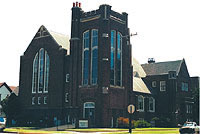 Members moved into the new building in February of 1925, occupying the basement for nearly two years before the sanctuary was completed. The church was dedicated on Sunday, January 30, 1927. Excerpts from a January 31, 1927 article from the Salina Journal about the church dedication describe the interior of the sanctuary as ... “like a cathedral, almost massive in appearance ... very dignified, giving one who enters an instant feeling that it is a place of worship, a place to stand in reverence. ... It has a high, cross-beamed ceiling and four large Gothic-shaped windows at either side, glazed with polychrome art glass, which shed to the interior a flood of warm-colored natural light. The dark-stained arching beams harmonize with the deep-colored wood traceries of the large windows. The altar and chancel is a focus of beauty with the baptistry in the center. Around and behind the baptistry a succession of designs in woodwork and marble lead up to the great stained glass window which commands immediate and reverent attention.” 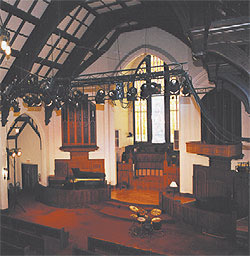 Stained glass dominant feature Stained glass artwork was included as one of the dominant features of this church when it was constructed in1923. As described by architect Charles Shaver, the leaded, colored art glass windows with tracery and oak framing as“... indicative of the ecclesiastic nature of the building is clearly shown on the exterior by the leaded, colored art glass windows with characteristic tracery and oak framing. They lend dignity to the gracefulness of the building and suggest the location of the sanctuary and other features of the interior arrangement...” Hopcroft-Pringle Glass Works of Kansas City, Missouri was engaged to produce fifty windows in varying sizes and intricacy of detail. Records from the architects office dated 1924 list the cost of the stained art glass as $2,925.00. The dominant window of triptych design is more than 13 feet at its base and rises to 24 feet at the point of the Gothic arch. The central panel is more than three feet wide and nine feet tall and depicts Christ in Gethsemane. The side panels have stained glass leaded designs which produce a stylized columnar effect with green and gold swirled glass outlined in ivory with rich brown accents. The central panel was donated by the Rash Bible Class in honor of their teacher, Mr. Howard C. Rash, a charter member of the church. Rash organized and chartered the first documented Sunday School Class in Kansas. The first State Sunday School Convention of the Christian churches was held in this church in 1881. Attendance averaged more than 100 per Sunday during the first decades of the 1900s. Prominent in the imposing north tower are six arched windows with colored and white opalescent glass in diamond designs. Each window measures four feet wide and eighteen feet in height. The doors leading to the sanctuary are of darkly stained oak frame and tracery with inserts of softly swirling translucent lavender, green and milky white art glass. This same art glass is used in the eight panel doors at the back of the church. These doors, each 4’ 8” by 9’ 5”, and more than 2 inches thick, partition the back section of the church to house congregation overflow. Paying the Bill In a few short years, the depression period made it all but impossible to reduce the debt on the building. However, during the ministry of George I. Meyers, $15,000.00 was raised to refinance a loan for the church building and the purchase of a parsonage. In 1944 the original mortgage was burned. At the annual meeting in December 1948, during Dr. L.V. Freeman's ministry, there was a mortgage burning to symbolize the total clearance of debt on both church and parsonage. First Christian Church sells building By the early 1990s the church had deteriorated and was in need of expensive repair work. The benefits of building a new church clearly outweighed repairing the existing church due to the state funding available for such projects. The congregation had depleted to the point that a facility of this size was no longer economical for them. A new church was built at 2727 E. Crawford. The central panel of art glass depicting Christ was taken from the old church and installed in the new church. Other than the glass panel and a few of the original pews, the original church remained intact. In March, 1996 the First Christian Church of Salina transferred ownership to Chad Kassem. Chad Kassem purchases church Chad Kassem, owner of Acoustic Sounds, orginally purchased the old church in downtown Salina for storage of inventory overage from his mail order music catalog business. Though the former First Christian Church retained much of its original beauty it was desperately in need of repairs. Plaster walls were crumbling due to a leaky roof, the heating system was non-functional and the original wiring was more than a bit "iffy." 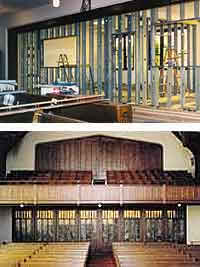 A full-time construction crew was hired to restore the badly decayed walls and repair the roof and heater. On several occations the local building supply stores were completely depleted of plaster. In the end, it would require nearly two tons of dry plaster to repair the church walls. A full-time construction crew was hired to restore the badly decayed walls and repair the roof and heater. On several occations the local building supply stores were completely depleted of plaster. In the end, it would require nearly two tons of dry plaster to repair the church walls.Despite its condition, the church served its original purpose — to store the warehouse's overflow inventory. At one point, Kassem even toyed with the idea of making it his residence. But it wasn't until after the purchase that Kassem realized the church's true potential. The spring of 1997 was the beginning of what was to become an Acoustic Sounds milestone. Engineers test acoustics The church's naturally occurring acoustics were phenomenal. After consulting with Neil Muncy, David Baker and Joe Harley about a live performance, they came to check out the sound quality. And sure enough it was, as Kassem says, "preem." The church had obviously been built for good acoustics so everyone could hear His word, but these acoustics were extraordinary, perfect for not only a performance hall, but a recording studio as well. Muncy was hired to engineer the project. Warren Ediger, a Salina architect, was hired to design the plans for the control room that was to be located at the back of the sanctuary Muncy arrived in Salina in spring of 1997 for the first in a series of trips to work on the studio design. His notable specialty is power distribution and proper grounding. As a result of his findings, more than $60,000 was spent on a complete new electrical service into the building. Using only the finest panels, breakers and surge suppression equipment, the studio power system was installed. Finally, in order to acheive the highest standard of performance, the city of Salina installed a transformer designated to provide the studio with its own private power source. The mixing console is a 36-input Neve 5106, purchased from Fox Broadcasting. It was restored and modified for our own special use. More than 1,000 man hours were required to restore it, upgrading thousands of capacitors and op amps. The studio's recording area is the sancuary whic is 77 feet long, 52 feet wide and 40 feet high. For comparison, Abbey Road Studio One is 94 feet long, 55 feet wide and 42 feet high. Eight huge oak doors with stained glass insets partition an area that was originally used for congregation overflow. Today, those same heavy doors, 4' 8" by 9' 5", and more than 2 inches thick, now close to conceal a state-of-the-art control room loaded with vintage analogue equipment. The original structure of the church has remained as untouched as possible. The studio is concealed so well that the church is still utilized by local couples for weddings. 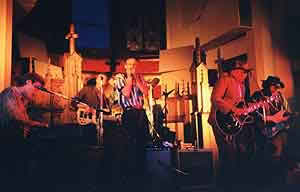 Jimmy Rogers performs concert By August of '97, much of the aesthetic repair work on the church was done, and construction had just begun on the studio. Kassem brought in Jimmy Rogers, APOs first recording artist, for a live performance. The single performance was scheduled for 8 p.m. on Monday, Aug. 25, 1997, and it was standing room only. Although referred to as the "former First Christian Church" (it had not yet been named) people found their way to its location in droves for an intimate performance by this legendary blues artist. Seating for 400 was available including the balcony, and there wasn't a bad view in the house. Blue Heaven Studios christened It wasn't until early 1998 that the church was officially named Blue Heaven Studios by Joe Harley, producer for AudioQuest and a close friend of Kassem. And how fitting. Kassem's true passion is the blues, and his goal was to record as many remaining blues legends as he could. Of course new talent was sought as well, but with the original blues masters fading, it became clear that there was work to be done. "There's no great way to say it," Kassem told the Salina Journal, "I want to record them before it's too late." BHS records first APO albums As construction continued on the main studio, Muncy worked to create an interim studio. It was located directly below the stage in the church basement, complete with visual and audio communication between the engineer and artist. On Feb. 14, 1998, APO christened Blue Heaven Studios with its first recording. The artist was Chicago blues great Jimmie Lee Robinson. Kansas City's Little Hatch came to observe Robinson's recording session and ended up laying down tracks for his own recording, Goin' Back. Although the analogue recordings were captured in a temporary studio, 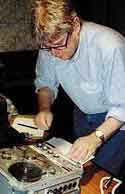 the acoustics in the church were as pure as expected. the acoustics in the church were as pure as expected."There's nothing like it, " said David Baker, a highly sought-after recording engineer from New York City. Producers utilize studio Chad Kassem continues to work towards fullfilling his dream of recording blues legends on his APO label. The studio employs Jimmy D. Lane, Music Director, John Brandt, Engineer/Manager and Julie Hess, Designer/Photographer. The studio can be rented by the hour, the day or the week. There are also package options available to new talent needing recording services and production assistance such as engineering, mastering, photography, design and pressings of LPs and/or CDs. High-profile producers such as Joe Harley of AudioQuest and John Atkinson of Stereophile have utilized this beautiful church with incredible sound. John Atkinson of Stereophile states, "Once word gets out about what a great-sounding studio BHS is, you'll be booked solid." |